
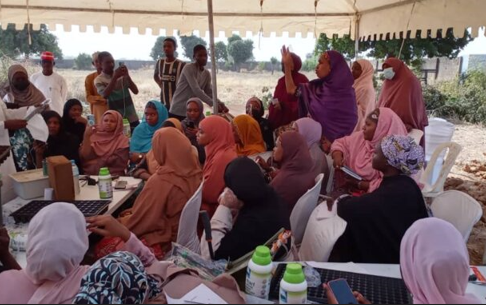
The Harvest Your Future Initiative, in partnership with the Garden to Greatness Project, has organised a two-day capacity-building programme, aimed at empowering women in modern agriculture.
They also trained 100 women in climate-smart agriculture and smart farming techniques to boost food production and improve household livelihoods.
Speaking at the event, the programme lead and sponsor, Hajiya Halima Zawiyya, said her experience as a farmer showed that despite women’s significant contributions to agriculture, they are often denied ownership and decision-making power over farms. According to her, this limitation prevents women from fully benefiting from their efforts, particularly in accessing credit facilities and agricultural support.
“We want to place women at the centre of agricultural production so they can farm independently, see the results of their labour, and confidently say, ‘this is my farm,’” Halima said. She explained that the initiative is designed to enable women to produce quality food not only for their families but also for the wider community.
Halima Zawiyya stressed that in view of the rising incidence of diseases and Nigeria’s heavy reliance on imported food, it has become critical for people especially women to know what they consume. “That is why we adopted the theme ‘Know What You Eat.’ We will plant together, harvest together, and in two months’ time, participants will bring their produce for a showcase of what has been achieved,” she added.
She further explained that smart farming makes it possible to practise agriculture even without owning land, noting that crops can be grown using modern methods such as container and soilless farming systems. “No woman should say she has no space; farming does not have to be done only on the ground,” she emphasised.
In his remarks, the Project Manager of Garden to Greatness Project and General Manager of Dantata Agricultural Services said the objective of the programme was to equip young women with modern, Climate-smart Agriculture. He noted that many greenhouses used in Nigeria are not suitable for the high temperatures common in northern parts of the country, leading to frequent crop losses, particularly for vegetables that are sensitive to heat.
Also, Katung lists roads, healthcare, electrification as priorities for Southern Kaduna
To address this challenge, he said the organisation partnered with stakeholders to introduce non-plastic greenhouse materials that allow airflow and water penetration while protecting crops from excessive heat. According to him, this innovation will significantly reduce losses and improve yields.
The project manager also disclosed that the training site was generously provided by Alhaji Tajuddeen Dantata to support the training of the 100 women. He commended Dantata for his contribution, describing it as vital to the growth of agriculture and the promotion of sustainable food production.
The training programme attracted leading agricultural experts, including Dr. Kamal Mustapha Tarban Gaya, Dr. Wajiha, and Dr. Aisha Maiwada Ahmad, Head of Training and Extension, who delivered lectures and practical guidance on modern farming techniques and strategies for improved food production.
Organisers of the programme expressed optimism that the initiative would serve as a key platform for empowering women, reducing poverty, and enhancing food security, while ensuring that women occupy a central and recognised role in Nigeria’s agricultural sector.
